



375,000 Followers and Almost No Profit – 6 Months Later: $37,000+ a Month
How a Brazilian automotive creator kept making car content while an entire monetization operation worked behind the scenes.
Project Snapshot
-
Industry: Automotive content
-
Market: Brazil
-
Audience: 250,000 TikTok followers and 125,000 YouTube subscribers
-
Content focus: Luxury and high-end vehicles
-
Monthly output: Four YouTube videos and approximately 15 short-form videos
Existing Monthly Revenue
-
Brand sponsorships: $2,500
-
Paid features: $250
-
YouTube and TikTok monetization: $1,500
-
Total revenue: $4,250
Monthly Operating Costs
-
Vehicle rentals
-
Travel
-
Production
-
YouTube editing
-
Short-form editing
Dealerships provided vehicles in only about one out of every five cases, leaving the creator to rent most of the cars featured in his content.
Total monthly expenses ranged from $3,000 to $4,250, leaving him with a typical profit of just $0 to $1,000 per month.
The audience was substantial, but the business behind it was barely treading water.
The Stakes
The Non-Negotiables: The Car Brand Had to Come First
Scalajan’s model is built around managing binary options affiliate businesses for creators with established audiences. In this case, the opportunity was to apply that system to a large but under-monetized automotive following.
The new business had to generate meaningful revenue without pushing trading into the center of the creator’s public content or weakening the brand that made the audience valuable.
Five conditions were established before the campaign began:
-
He had to remain a car creator first.
-
Automotive content had to stay at the center of his YouTube and TikTok channels.
-
The new offer could not undermine engagement, audience trust, or existing platform revenue.
-
The creator could not become responsible for customer support, funnel management, education, or community operations.
-
The new revenue stream had to become predictable enough to reduce his dependence on sponsorships.
The initial goal was to generate at least $12,000 per month in affiliate revenue. That would give the creator more freedom to finance production without relying on a constant cycle of brand negotiations.
The Catch
Four Problems Had to Be Solved
-
The audience had little financial context
Most followers came for cars. They were not actively looking for binary options content, and many had little or no familiarity with the product. Sending that audience directly to an offer would have created confusion before it created interest. -
Promotion could weaken the creator’s brand
The creator had earned attention by reviewing and featuring high-end vehicles. If trading suddenly became a major part of his public content, the shift could feel like an abrupt commercial detour. The offer had to fit around the brand rather than compete with it. -
The existing revenue model was familiar but limited
Sponsorships produced the largest share of the creator’s income, but they were inconsistent, time-consuming to arrange, and often expensive to fulfill. Scalajan’s data also showed that frequent sponsored content reduced affiliate conversion. The creator would eventually need to rely less on the revenue source he already understood, even while the replacement was still being proven. -
A serious affiliate business required its own operation
Adding a link to a social media bio would not be enough. Prospects needed education, onboarding, customer support, follow-up, community management, and a clear path from initial curiosity to a first deposit. Building that operation himself would have taken the creator away from the content that made the opportunity possible.
The Central Strategy
Core Strategy: Keep the cars in front. Build the trading business behind them.
Guiding Principle: Never ask the audience to accept a new version of the creator.
His public content would stay centered on the luxury cars, vehicle reviews, and automotive lifestyle that had built his following.
What would not change:
-
No shift into trading tutorials
-
No forced promotional segments
-
No attempt to reposition him as a financial expert
How trading would be introduced:
-
Mentioned only when it fit naturally into the conversation
-
Framed as the secondary business helping fund vehicle rentals, travel, and production
-
Kept separate from the main automotive content
What happened after someone showed interest:
Interested followers were directed to a separate Telegram community, where Scalajan handled the education, support, onboarding, and conversion process.
The public brand stayed focused on cars. The affiliate business was built behind it.
The Strategy in Execution
What the Audience Saw
-
Occasional references that made sense within the existing content
-
A link to a free Telegram community
-
Brief calls to action delivered in the creator’s normal tone
-
Continued automotive and lifestyle content
-
Educational material for followers who chose to explore further
What Scalajan Built Behind the Scenes
-
Public and private Telegram communities
-
A complete registration and conversion funnel
-
Ten free educational videos
-
Twenty advanced videos available after a first deposit
-
Copy trading offers and deposit-based upsells
-
A dedicated customer support team
-
Onboarding and follow-up systems
-
Ongoing analysis of content, scripts, offers, and conversion performance
Phase 1: Learn Before Scaling
For the first two weeks, the creator did not directly promote the offer.
What the audience saw:
-
Occasional references to the secondary business
-
Mentions only when they fit naturally into a video or conversation
-
No hard sell and no push for immediate traffic
What Scalajan was learning:
-
The questions people asked most often
-
The objections holding them back
-
The areas where more education or support was needed
The goal was to understand the audience before increasing exposure.
Early result: 43 first-time depositors in the first month, despite active acquisition running for only about half the month.
Phase 2: Increase Visibility and Improve Conversion
Once the initial system was working, the Telegram link was added to the creator’s YouTube and TikTok bios.
What changed:
-
The offer became easier to find
-
Traffic increased immediately
-
Scalajan had more real user behavior to analyze
What the team refined:
-
Support scripts
-
Educational content
-
Onboarding
-
Calls to action
-
The path from initial interest to first deposit
What the data revealed:
Formal promotion performed worse. When the message sounded too serious or sales-driven, retention and engagement declined. Shorter, more natural invitations that matched the creator’s personality converted better.
Key takeaway: The offer did not need a separate promotional voice. It needed to sound like the person the audience already trusted.
Phase 3: Strengthen Engagement and Repeat Activity
As the communities matured, Scalajan shifted its focus from initial conversion to the full customer journey.
What members received:
-
Beginner education
-
Market analysis
-
Trade examples
-
Withdrawal proof
-
Ongoing guidance inside Telegram
What the creator continued sharing:
-
Cars
-
Travel
-
Restaurants
-
Watches
-
Everyday moments from his life
This mix kept the community connected to the automotive brand that had brought people in.
Why it mattered: Members were not being asked to follow a newly created trading personality. They were following the same creator into another part of his business.
The Results: Growth, Conversion, and Continued Activity
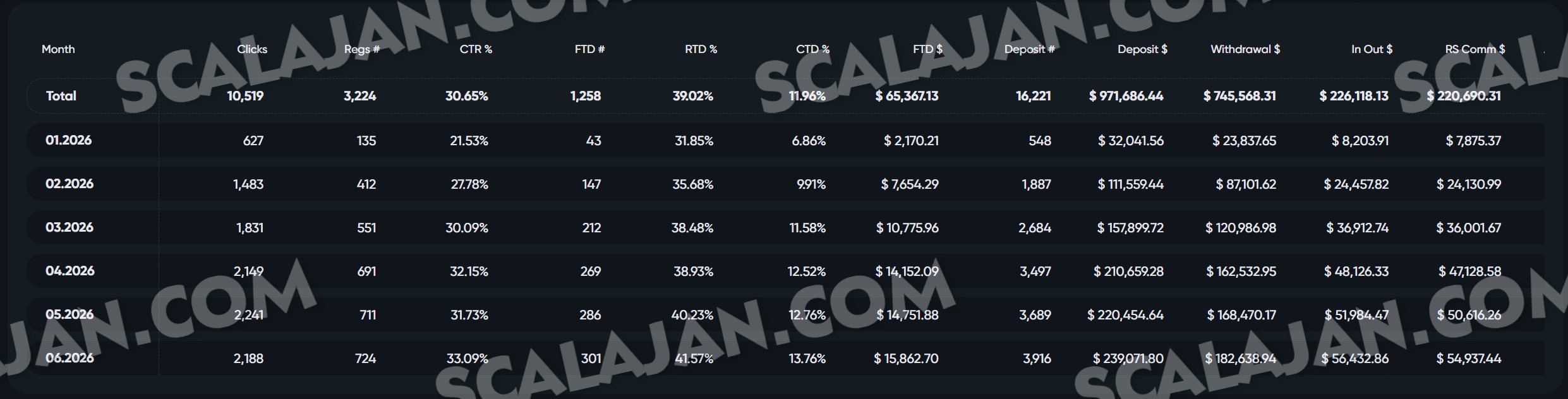
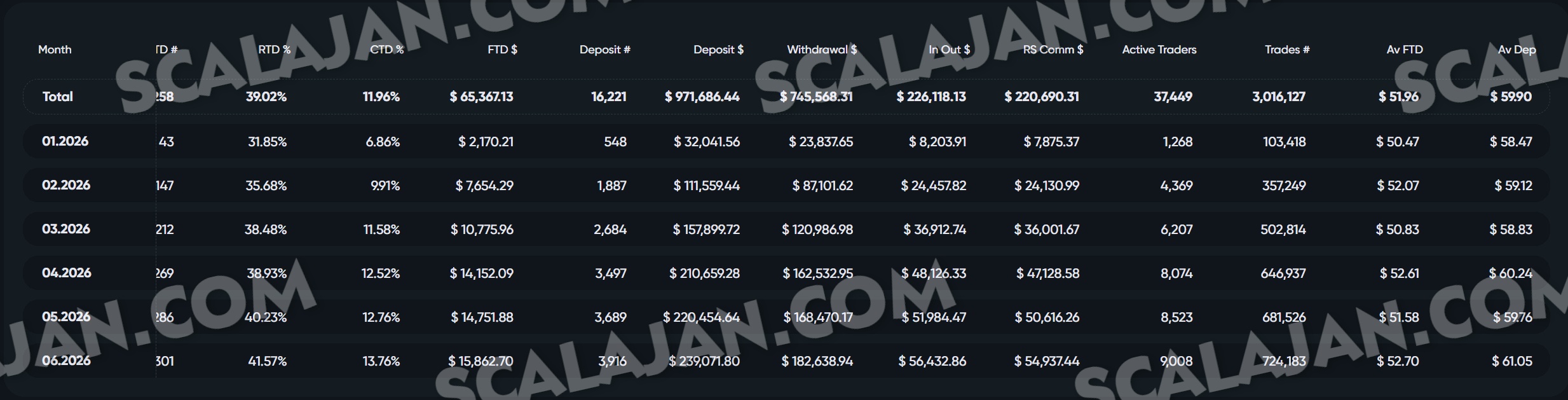
The Scalajan profit-sharing model gives 70% to the creator, and we maintain 30% for the build-out and continued support.
In June, the monthly revenue reached a high of $54,937. So at 70%, the creator made $38,455.90 in June alone.
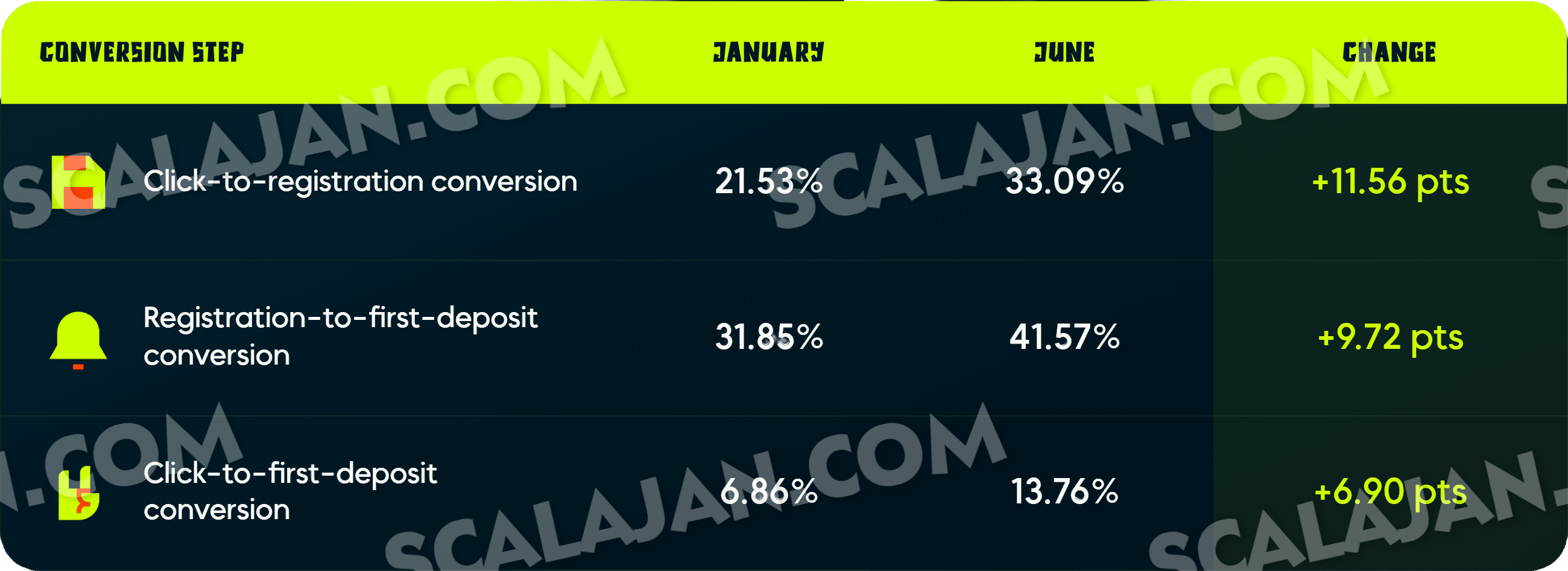
By June, roughly one in three visitors registered. More than four in ten registered users became first-time depositors.
Conversion Also Outpaced the Broader Market Data
For comparison, the supplied platform data showed that 14.99% of registered Brazilian users typically made a first deposit. Across this campaign, that figure reached 41,57%.
The average deposit was also higher: $59.90 for the campaign compared with the average $42.88 in the broader Brazilian data.

Detailed breakdown of conversion rates, average deposits, and lifetime value following the strategy execution.
The Business Generated Continued Activity
Across the six-month reporting period, the campaign produced:
-
1,258 first-time depositors
-
16,221 total deposits
-
$971,686 in total deposit volume
-
$220,690 in revenue-share commissions
-
More than 3 million trades
The gap between first-time depositors and total deposits is significant. The business was not built entirely on users registering and depositing once. Many continued depositing and trading after entering the system.
The Conclusion
A Stronger Business Without Changing the Brand
After six months, the creator’s public role looked much the same.
What stayed:
-
Automotive content remained the focus
-
He continued reviewing vehicles and working with dealerships
-
His audience still saw the creator they originally followed
-
He remained focused on content rather than operations
What changed:
-
Sponsorships were no longer the only meaningful source of revenue
-
A second revenue stream helped support production costs
-
Scalajan managed the funnel, education, support, and community
-
Growth no longer depended on the creator taking on another full-time role
The project succeeded because the creator did not have to change his content, rebuild his public image, or take on the operational work behind the new revenue stream.
He kept making automotive content while Scalajan handled the systems, support, and ongoing optimization needed to make the business work.
Six months later, the same audience that had produced little dependable profit was supporting a $37,000+ monthly revenue stream.
The creator was still doing the same work that had built his following. The difference was that, for the first time, there was a highly profitable business behind it capable of carrying the weight.